AnyHand: A Large-Scale Synthetic Dataset for RGB(-D) Hand Pose Estimation
NeurIPS, 2026
A pipeline to build a large-scale synthetic dataset for RGB(-D) hand pose estimation.


The grant was awarded on 12/02/2025 (S$ 3,078,720.00), and started on 01/09/2025 and will end on 30/08/2030.
The aim of From Pixels to Physics is to create a realistic natural world adhering to physical principles, rather than dealing with only the realistic pixels as in traditional image, video, and 3D synthesis. Physics-based natural world creation is challenging because it requires a holistic interpretation of scenes and objects within it, including but not limited to appearance, geometry, motion, materials, collision, occlusion, gravity, interaction, mass, force and sound.
To achieve the objectives of From Pixels to Physics, the project focuses on the following key objectives:
ArticraftAgentic system for scalable generation of articulated 3D assets
Syn4DA large-scale synthetic multiview 4D dataset with dense annotations.
NOVA3RAmodal 3D reconstruction of visible and occluded regions from sparse views
Instruct ParticulateFeed-forward articulated structure inference for physically interactive 3D objects
A pipeline to build a large-scale synthetic dataset for RGB(-D) hand pose estimation.
An agentic system that enables scalable generation of articulated 3D assets.
A feed-forward approach that utilizes kinematic prompt to guide 3D object articulation.
A large-scale synthetic multiview 4D dataset with dense geometry, tracking, camera motion, and human pose annotations.
A feed-forward approach that directly infers underlying articulated structure from a single static mesh
A video generator is reformulated as a 4D VAE to jointly reconstruct dense geometry and motion from monocular videos.
Given a monocular video, Mesh4D reconstructs a complete 3D mesh and tracks its motion across frames.
NOVA3R recovers complete, non-overlapping 3D geometry, reconstructing visible and occluded regions with physical plausibility.
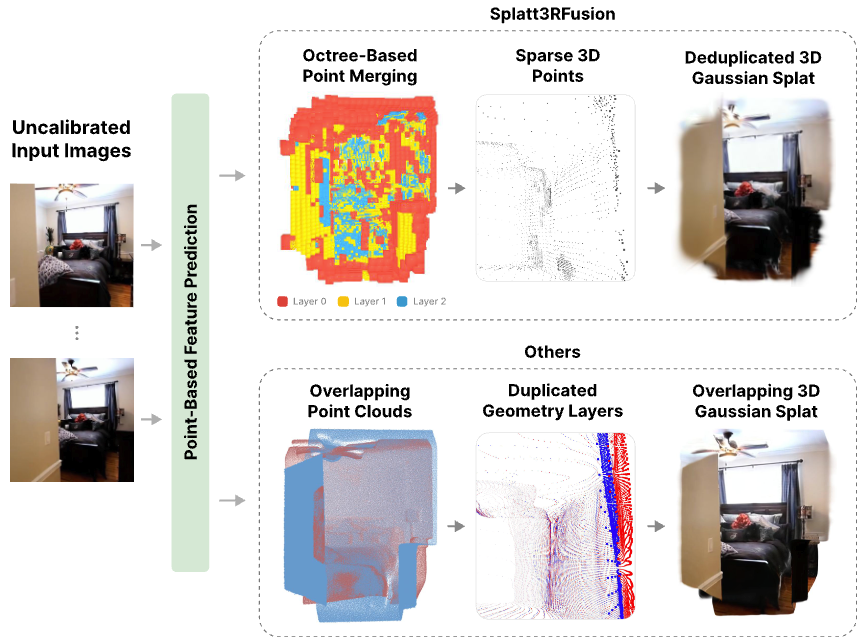
A method to reconstruct compact and high-quality 3D Gaussians using Octree-based point fusion.
 arxiv
arxiv