Lower single-joint collision rate
vs. Articulate-Anything · 31.2% → 1.7%
1 PVG, Nanyang Technological University2 ETH Zurich3 VGG, University of Oxford4 Microsoft5 University of Cambridge
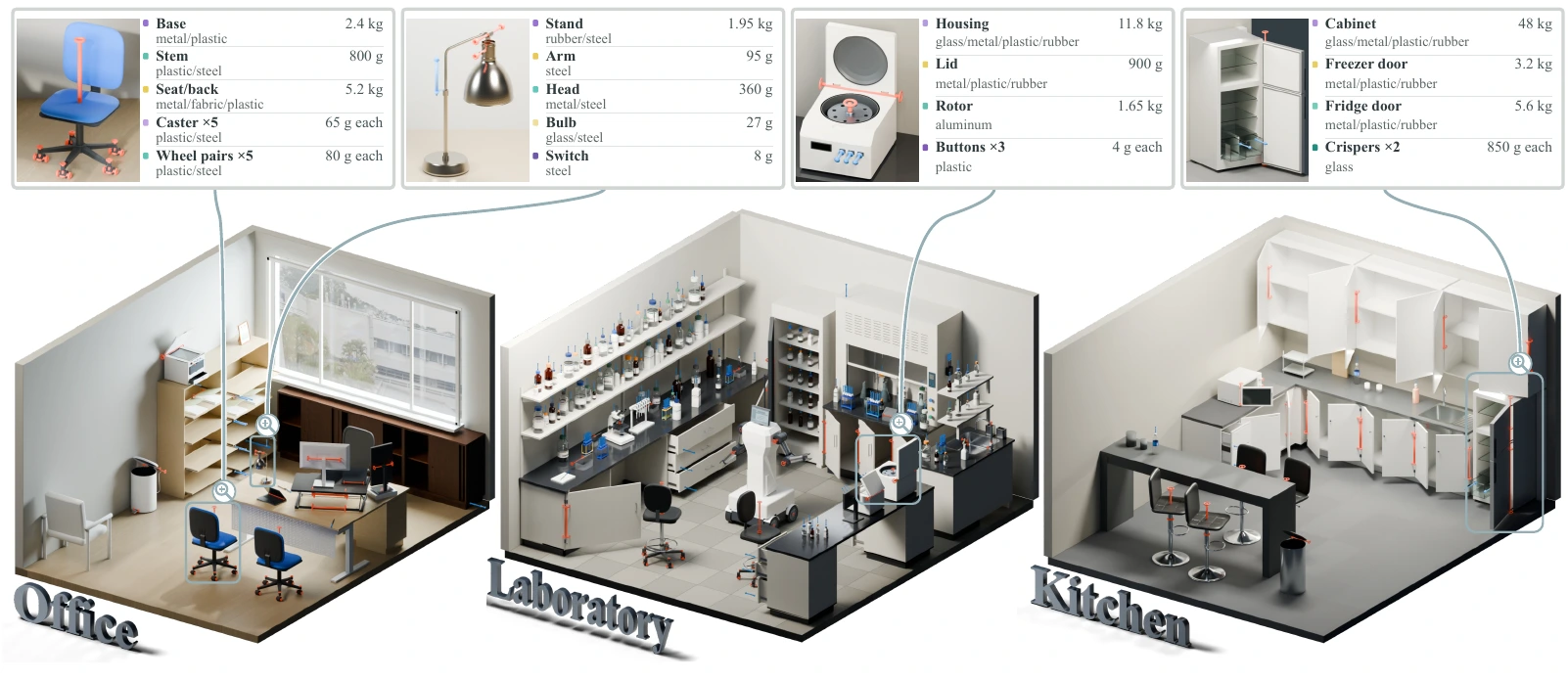
Office · Original photo taken in Chuanxia Zheng’s office
Explore this roomvs. Articulate-Anything · 31.2% → 1.7%
vs. Codex · 86% → 98%
vs. Codex · 21.1% → 43.3%
Relative improvements over the best non-Artisan baseline for each metric. Physics scores use Artisan (GPT-6 Astra).
Red boxes highlight incorrect motion detected by physical collision checks.
Red border: execution failed.
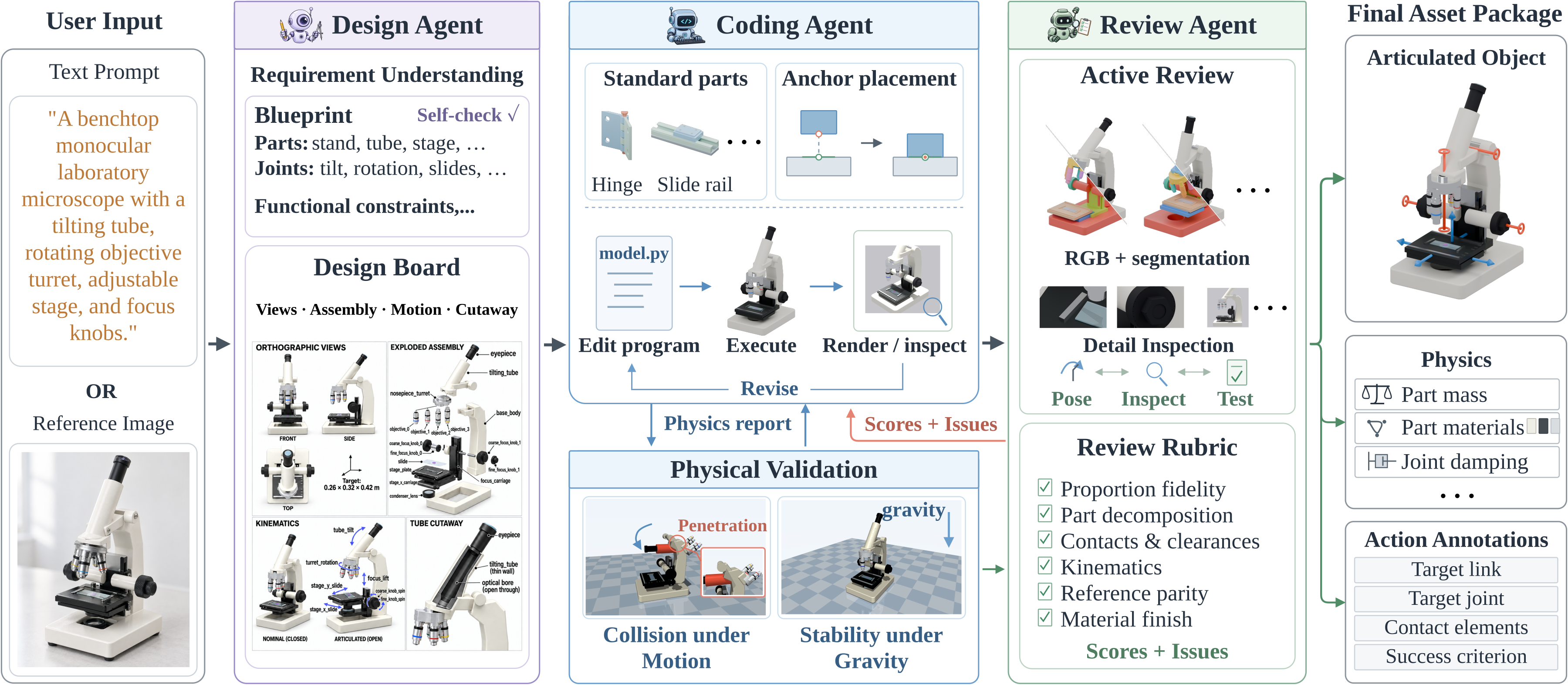
Design, Coding, and Review agents separate planning, construction, and independent assessment.
Simulation detects collisions and instability, then guides repairs to geometry and physical parameters.
More than 10 models evaluated on appearance, articulation, physics, robot tasks, and human preference.
In this paper, we study physically grounded articulated 3D asset generation—moving the goal from reproducing how objects look to capturing how they move and function. Inspired by the literature on procedural and agentic generation, we present Artisan, a system that extends the latest method Articraft by introducing a multi-agent pipeline with physical simulation feedback, enabling comprehensive attributes beyond geometry, appearance, and physically plausible articulation, such as collision-free motion, stability under gravity, and accurate mass and material properties. Furthermore, we construct a unified benchmark spanning four key aspects: spatial fidelity, physical plausibility, downstream task performance, and overall quality. The benchmark encompasses 100 reference assets from ArtVIP and LightWheel, 50 stability prompts, and 50 ABO objects with reference masses, with protocols evaluating various metrics. Through extensive evaluation of more than 10 representative models, Artisan achieves competitive spatial fidelity while attaining the lowest collision rates and highest stability rates among the evaluated methods. Together, our system and benchmark establish insights for advancing 3D generation towards physically plausible, functionally usable assets.
4 aspects, 5 datasets, and more than 20 metrics
ArtVIP · collision under motion
| Rank | Method / backbone | Single-joint collision ↓ | Double-joint collision ↓ | Multi-joint collision ↓ |
|---|---|---|---|---|
| 1 | ArtisanGPT-6 Astra | 1.7% | 3.7% | 13.0% |
| 2 | ArtisanGPT-5.6 Sol | 1.9% | 4.8% | 16.4% |
| 3 | ArtisanGPT-5.5 | 3.5% | 6.4% | 12.3% |
| 4 | Articulate-Anything | 31.2% | 39.2% | 32.8% |
| 5 | CodexGPT-6 Astra | 32.4% | 47.0% | 63.7% |
| 6 | ArtisanGPT-5.5 · without physics | 37.5% | 47.3% | 77.6% |
| 7 | ClaudeFable 5.1 | 39.9% | 51.7% | 64.7% |
| 8 | ArticraftGPT-5.5 | 44.5% | 57.5% | 79.4% |
| 9 | ArticraftGPT-6 Astra | 45.5% | 60.7% | 78.8% |
| 10 | AgyGemini-Flash-3.8 | 46.3% | 65.6% | 81.5% |
| 11 | PhysX-Anything | 58.4% | 77.6% | 81.3% |
| 12 | Instruct-Particulate | 70.4% | 90.4% | 98.7% |
| 13 | URDF-Anything+ | 84.6% | 99.3% | 100.0% |
| — | NeRF2Physics | — | — | — |
| — | PUGS | — | — | — |
Best scoreSecond-best score= Shared rank— Not reported
All 15 rows from Table 2, including backbone variants and the physics ablation. An em dash means the paper reports no result; that row is unranked for the selected metric.
Ranks use the paper’s reported values for the selected metric; ties share a rank. Each dimension is evaluated separately. Click a column heading to rank by that metric.
Overview charts: spatial and physical results use GPT-6 Astra for Artisan, Articraft, and Codex; spatial results are on ArtVIP. Downstream results compare training compositions with a π0.5 policy on held-out native assets. Human preference follows visual inspection and physical interaction.
Evaluation protocols and dataset composition: Sections 4.1–4.2 and Appendix B ↗
@misc{cai2026artisan,
  title  = {Towards Physically Grounded Articulated 3D Assets: A Multi-Agent Pipeline and Benchmark},
  author = {Cai, Xudong and Zhu, Ruijie and Shang, Haoliang and Li, Ruining and Pollefeys, Marc and Wu, Shangzhe and Vedaldi, Andrea and Zheng, Chuanxia},
  year   = {2026},
  eprint = {2610.13947},
  archivePrefix = {arXiv},
  url    = {https://arxiv.org/abs/2610.13947}
}